You see them on the siding, under the eaves, in the garage corner—those peculiar, mud-colored lumps that look like something out of a miniature pottery class. Dirt daubers, or mud daubers, trigger that instant "wasp" alarm. But what if I told you that 90% of the panic is misplaced? After years of watching them, and after talking to entomologists from places like the University of Kentucky's Department of Entomology, I've come to see them not as pests, but as fascinating, beneficial neighbors. Most guides get the basics right but miss the crucial nuances that separate effective management from pointless warfare.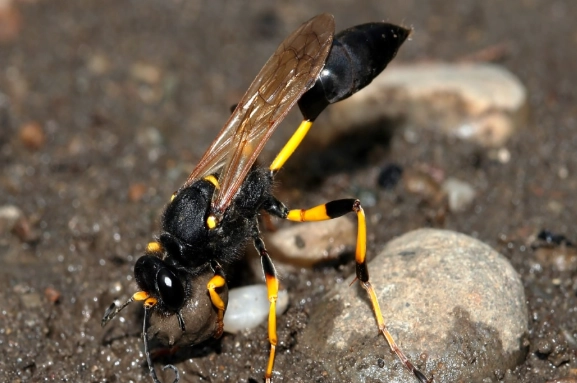
Let's cut through the noise. This isn't just about knocking down a nest. It's about understanding a unique insect, leveraging its benefits, and managing it wisely only when necessary.
In This Guide: Your Quick Navigation
- What Exactly Are Dirt Daubers?
- How to Spot the Difference: Key Identification Features
- The Danger Myth: Are Mud Daubers a Real Threat?
- Your Prevention Playbook: Keeping Nests Off Your Property
- Safe Removal: A Step-by-Step Guide for Active and Old Nests
- Common Mistakes Even Smart Homeowners Make
- Your Questions, Answered (Beyond the Basics)
What Exactly Are Dirt Daubers?
Forget the hive mind. Dirt daubers are solitary wasps. Each female is a single mom, an independent contractor. She doesn't have workers, soldiers, or a queen to report to. Her entire mission in life is to 1) find mud, 2) build a series of tubular cells, 3) hunt and paralyze spiders, 4) stuff each cell with spider provisions, 5) lay an egg on the stash, and 6) seal it up. Then she's done. Her offspring develop in isolation, feeding on the spiders, and emerge later to repeat the cycle.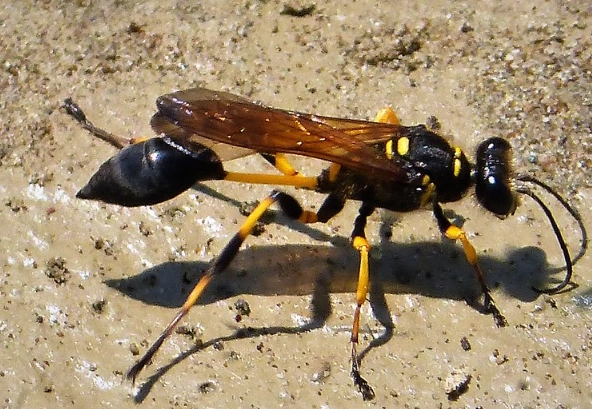
This solitary nature is the key to everything. It means no colony to defend. No sentries. No coordinated attacks. Her behavior is driven by provisioning, not protection.
How to Spot the Difference: Key Identification Features
Not every long, skinny wasp is a mud dauber. Misidentification leads to unnecessary fear. Here’s your field guide.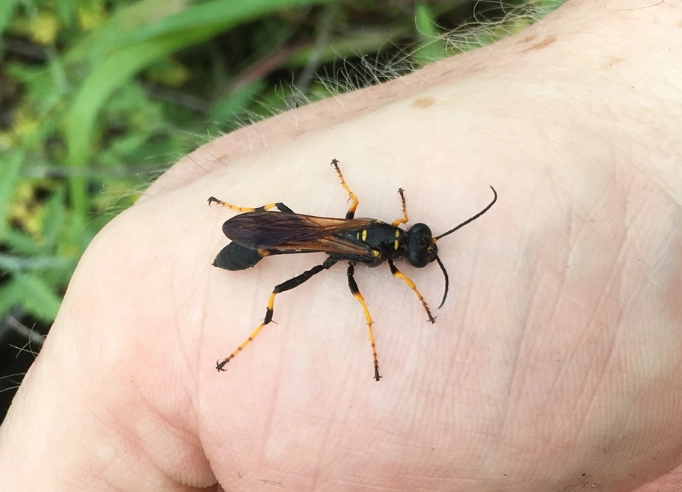
The Telltale "Thread-Waist"
All mud daubers have an extremely long, thin segment (the petiole) connecting their abdomen to their thorax. It looks like a piece of thread. This is the single easiest feature to spot.
Color Variations: The Three Main Players
You'll typically encounter one of three types, and color is a quick clue:
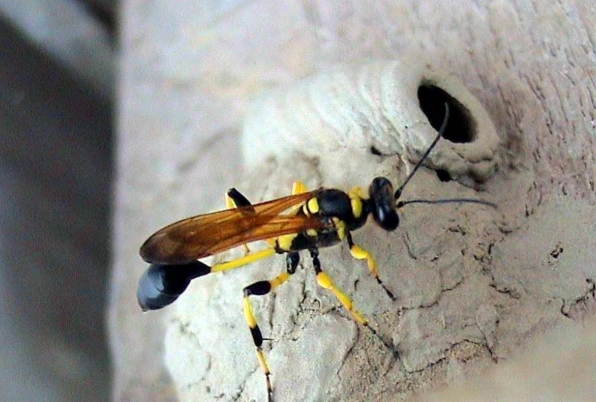
The Black & Yellow Mud Dauber (Sceliphron caementarium): This is the classic. It's mostly black with smoky wings and vivid yellow markings on its legs and thorax. Its nests are rough, lumpy globs of mud, often with multiple tubular cells.
The Blue Mud Dauber (Chalybion californicum): This one is stunning—a metallic blue or blue-black, almost like a jewel. It's a bit of a cheat; it often doesn't make its own mud. It takes over old nests of other mud daubers, refurbishes them, and stocks them. It specializes in hunting black widow spiders.
The Organ-Pipe Mud Dauber (Trypoxylon politum): Dark, slender, and builds the most architecturally impressive nests: clusters of long, parallel mud tubes that resemble, you guessed it, organ pipes.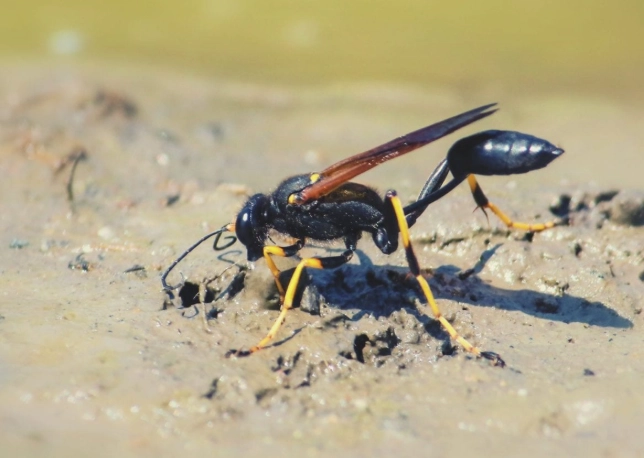
The Danger Myth: Are Mud Daubers a Real Threat?
Let's be blunt: the risk of being stung by a mud dauber is vanishingly small for the average person. I've gently nudged them off walls with my finger (not recommended, but it makes a point). Their sting is reserved for their spider prey. They lack the instinct to defend a nest because there's no collective to defend.
The real "danger" is twofold, and both are often overblown:
1. The Clogging Risk: They love to build in small, tubular openings. I once saw a motorcycle that wouldn't start because a mud dauber had packed the entire tailpipe with mud. Keyholes, electrical boxes, gas grill burners, and vent pipes are fair game. This is a nuisance, not a health hazard.
2. Allergic Reaction: As with any bee or wasp sting, a person with a severe allergy could react. But you're orders of magnitude more likely to be stung by a yellow jacket at a picnic than by a mud dauber in your lifetime.
Your Prevention Playbook: Keeping Nests Off Your Property
If you don't want the mud stains or the potential for clogged vents, prevention is straightforward. It's about making your space less appealing than the neighbor's.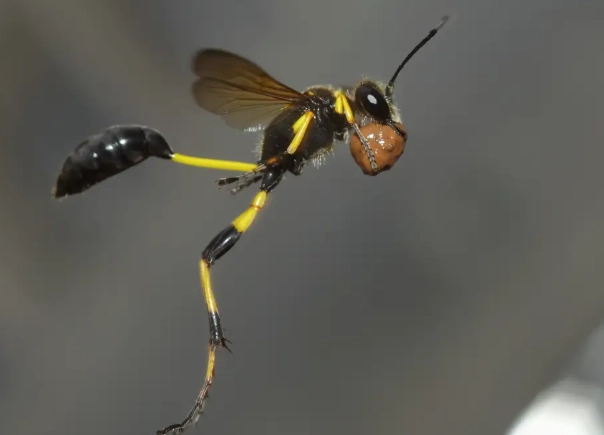
Eliminate Mud Sources: This is the most overlooked step. They need wet, clay-rich soil. Fix leaky outdoor faucets, downspouts, and air conditioner drip lines. If you have a natural muddy spot, consider covering it with gravel.
Seal Entry Points: Caulk cracks in siding, soffits, and around window frames. Install fine mesh (1/4 inch or smaller) over vents, especially attic and crawlspace vents.
The Fake Nest Trick (It Works): Mud daubers are highly territorial with each other. Hang a few commercial "wasp deterrent" nests (those paper lantern-looking things) or even make your own from brown paper bags in early spring. Place them under eaves, in corners of porches, and in open garages. The thinking is they'll see an "occupied" territory and move on. In my experience, it reduces activity by about 70%.
Safe Removal: A Step-by-Step Guide for Active and Old Nests
You've found a nest. Don't grab the can of spray. Follow this logic tree instead.
Step 1: Assess Activity. Watch the nest from a safe distance (like from inside through a window) for 15-20 minutes. Do you see a wasp coming and going? If yes, it's active. If you see no activity for 24-48 hours, it's likely inactive (the larvae are developing inside).
Step 2: Choose Your Time. If you must remove an active nest, do it at night or very early dawn when the female is inside and cool/torpid. Use a red-light flashlight if needed; wasps don't see red light well.
Step 3: Gear Up. Wear long sleeves, pants, gloves, and safety glasses. It's more for peace of mind and protection from falling debris than from the wasp.
Step 4: Removal Method. For an inactive, dry nest: Simply use a putty knife or paint scraper to pop it off the surface. Have a trash bag open underneath to catch it. Dispose of it in the regular trash. For an active nest you've chosen to remove: Place a large, clear plastic bag over the entire nest. Quickly detach the nest from the surface so it falls into the bag. Immediately twist the bag closed and seal it. Place it in the freezer overnight to humanely euthanize the wasp, then dispose.
Step 5: Clean Up. Scrape off any residual mud. A stiff brush and soapy water usually works. This removes the scent and texture that might attract a new builder.
Common Mistakes Even Smart Homeowners Make
I've seen these errors repeatedly.
Mistake 1: Spraying an active nest during the day. This is the biggest waste of chemical and creates the only scenario where you might get stung. You're agitating a solitary insect that otherwise wouldn't care about you.
Mistake 2: Assuming all nests are current. Most nests you see by mid-summer are already sealed and inactive. You're removing a historical artifact, not an active threat.
Mistake 3: Ignoring the mud source. Remove ten nests, but if you have a perfect mud puddle by your foundation, you'll get ten more. Address the resource.
Your Questions, Answered (Beyond the Basics)
The bottom line is this: dirt daubers deserve a reputation rehab. They are not the enemy. Before you reach for the spray, take a moment to watch. You might just see a master architect and a dedicated pest controller at work. Manage them for convenience, not out of fear. Seal up the spots you don't want them, let them have the out-of-the-way corners, and appreciate the complex, spider-reducing work they do for free.
LEAVE A REPLY
Your email address will not be published. Required fields are marked *