You're relaxing on your deck when you hear it—a persistent, dry, rasping sound coming from the eaves. Looking up, you spot a large, glossy black insect methodically chewing into the wood. Your first thought might be "termite!" or "carpenter bee!" but there's a good chance you're looking at a carpenter wasp. Unlike their social yellowjacket cousins, these solitary insects are often misunderstood. They're not out to swarm your picnic, but their wood-boring habits can cause genuine concern for homeowners. Let's clear up the confusion.
What You'll Find in This Guide
How to Spot a Carpenter Wasp (And Not Mistake It)
This is where most people get tripped up. Carpenter wasps are large, which immediately draws attention. But size alone isn't enough. You need a checklist.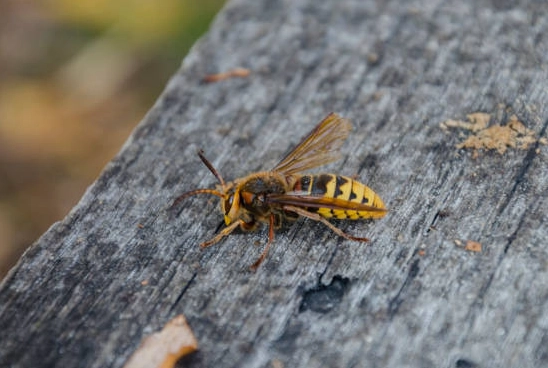
The Carpenter Wasp Look: Picture an insect about ¾ to 1 inch long. Its body is almost entirely a deep, metallic blue-black or black, often with a slight bluish sheen in the sun. The wings are a dark smoky color, sometimes with a faint violet tint. The abdomen is long and cylindrical, connected to the thorax by a very narrow "waist" (petiole)—this is a key wasp feature. Females have a straight, sturdy ovipositor at the tip of the abdomen, which doubles as a stinger.
Now, the common mix-ups.
A Common Mistake I See: Homeowners panic and call for "carpenter bee" extermination, only to find out they have carpenter wasps. The treatment approach and urgency are different. Misidentification wastes time and money.
| Feature | Carpenter Wasp | Carpenter Bee | Yellowjacket |
|---|---|---|---|
| Body Color | Glossy blue-black or black | Black & fuzzy yellow abdomen | Bright black and yellow bands |
| Abdomen | Smooth, shiny, cylindrical | Hairy, rounded | Smooth with distinct bands |
| Social Behavior | Solitary | Solitary | Highly social, lives in large colonies |
| Nesting | Bores into sound/rotting wood | Bores into sound wood | Paper nests in ground or cavities |
| Aggression | Low, females sting only if handled | Males can't sting, females reluctant | High, will defend nest aggressively |
See the difference? That black, smooth body is your biggest visual clue. If it's black and yellow and flying around your soda can, that's a yellowjacket—a different problem altogether.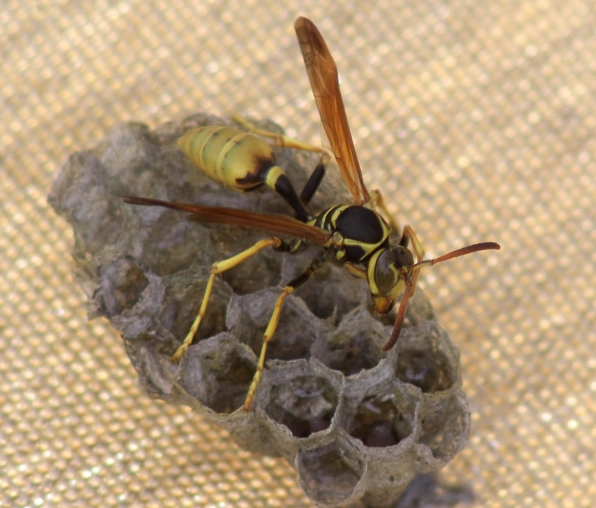
Inside a Carpenter Wasp Nest: The Life Cycle
Understanding their nesting habit is crucial to understanding the risk. They don't eat the wood like termites. They're excavators, using their strong mandibles to carve out tunnels for their young.
The female selects a site. She prefers soft, unpainted, or weathered wood. I've most commonly found them in:
- Old fence posts and rails
- The undersides of deck railings and eaves
- Dead tree limbs or logs (their natural habitat)
- Sometimes in structural timbers if they're old and exposed
She bores a perfectly round entrance hole, about the diameter of a pencil. Then, she excavates a short tunnel, usually a few inches long. Along this main tunnel, she constructs individual brood cells.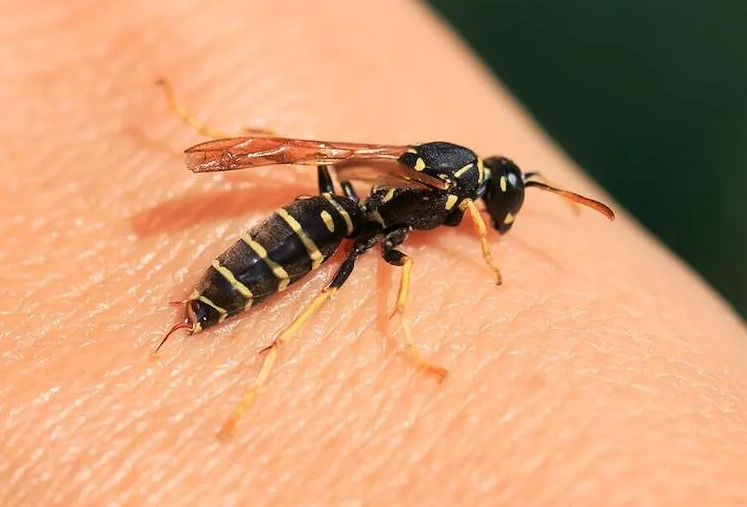
The Gruesome Nursery Strategy
Here's the fascinating and slightly macabre part. In each cell, she lays a single egg. Then, she goes hunting. Carpenter wasps are parasitoids of caterpillars, beetle larvae, and spiders. She paralyzes her prey with her sting—not killing it, but immobilizing it—and stuffs several into the cell with the egg. She seals the cell with a plug of chewed wood pulp.
The egg hatches, and the wasp larva has a fresh, living but motionless food supply right there. It eats, grows, pupates, and eventually chews its way out as an adult the following season. The entire process is solitary; the mother wasp does not care for the young after provisioning the cell.
The Real Risk of a Carpenter Wasp Sting
This is a major concern for people, and the fear is often exaggerated. Let's be precise.
Only female carpenter wasps can sting, as the stinger is a modified ovipositor. They are not aggressive defenders of their nest like yellowjackets or hornets. Their sting is primarily a hunting tool. I've observed them for hours near their nests without provoking an attack.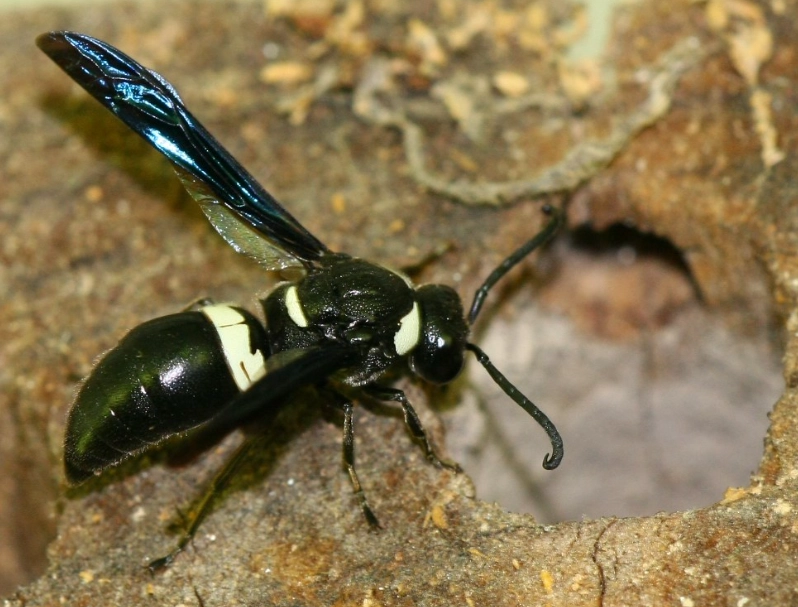
You would likely only get stung if you accidentally grabbed one, pressed against it, or somehow trapped it against your skin. The sting itself is reportedly quite painful—similar to other large wasp stings—due to their size. For most people, it results in localized pain, swelling, and redness that subsides in a few hours to a day.
The critical point: If you are allergic to bee or wasp venom, a carpenter wasp sting can trigger the same dangerous anaphylactic reaction. Know your allergies. If you're unsure and see multiple nests, extra caution is warranted.
When Should You Actually Worry About Damage?
Not every sighting requires a call to the exterminator. Here's my practical, property-focused assessment.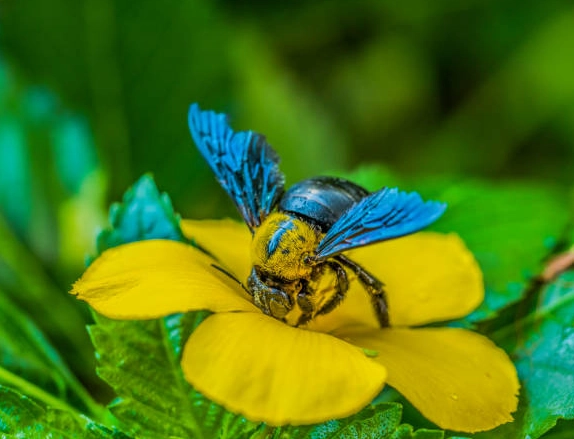
Low Risk Scenario: A single entrance hole in a non-structural piece of wood like a thick fence post, a dead tree branch, or an old garden bench. The wasps are recycling already decaying material. You can often leave them be as beneficial predators.
Medium Risk Scenario: Multiple holes appearing in the same timber, or activity in painted but peeling wood on your house trim. This indicates the wood is attractive (soft, moist) and repeated nesting could accelerate weathering and decay.
High Risk Scenario: Nesting activity in critical structural wood—roof eaves, support beams, deck joists, or window frames. Even though one wasp's tunnel is small, successive generations (or other pests exploiting the holes) can compromise the wood's integrity over many years. This is when you need a plan.
I once inspected a cabin where carpenter wasps had used old woodpecker holes in a log wall to start nesting. Over a decade, moisture got in, rot set in, and secondary infestations followed. The initial wasp damage was minor, but it was the open door for bigger problems.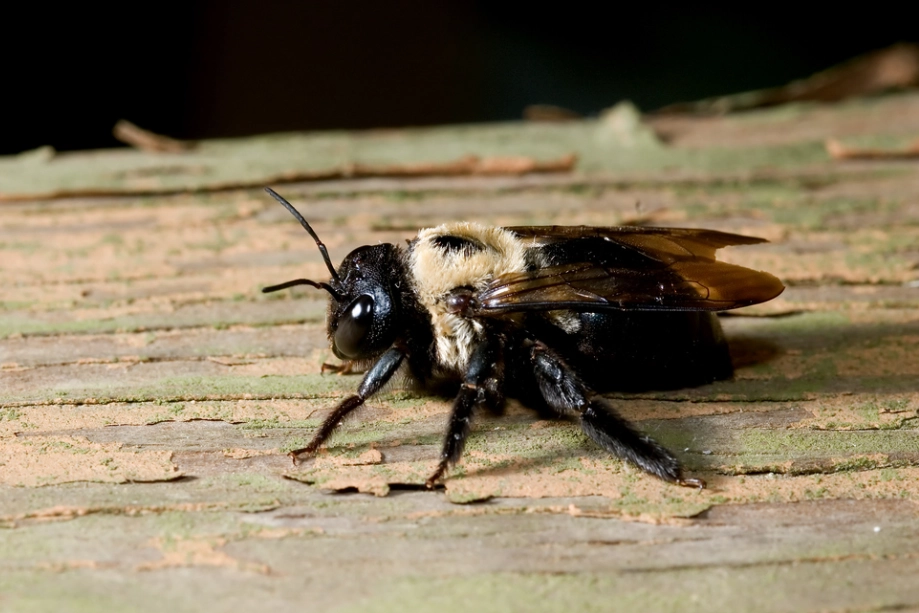
Your Options for Safe Carpenter Wasp Removal
If you're in a medium or high-risk scenario, you have choices. Your goal is to stop the nesting and protect the wood.
1. The Wait-and-Seal Method (Eco-Friendly)
This works for inactive nests. Identify holes that are not currently in use (no fresh sawdust, no wasp coming/going). In late fall or winter, when you're sure the adults have died off, seal the holes. Use a durable wood putty, caulk, or a wooden dowel coated with wood glue. Then, paint or stain the wood surface. A hard, painted surface is a strong deterrent for future females looking to nest.
2. Physical Deterrence and Exclusion
For areas under constant attack, like eaves, consider installing fine metal mesh or screening behind decorative fascia boards to block access to the vulnerable wood cavities. Ensure fire blocks and other building code requirements are considered.
3. Targeted Insecticidal Action
If an active nest needs to be dealt with, extreme caution is needed. Never plug an active hole—you'll trap adults inside who may chew out elsewhere. Insecticidal dusts labeled for wasp/bee control can be puffed lightly into the entrance hole at dusk when the female is inside. The dust is carried deeper into the nest. This is a job for a professional if the nest is high up or you're allergic. After treatment, wait a week or two, then seal the hole as above.
Avoid spraying liquid insecticides directly at the hole or the wasp. It's less effective and more likely to provoke a defensive sting.
4. Professional Pest Control
Hire a pro if: the infestation is large, nests are in hard-to-reach structural areas, or you simply aren't comfortable. A good professional will identify all nest sites, treat appropriately, and advise on long-term wood protection and exclusion methods. Ask them about integrated pest management (IPM) approaches.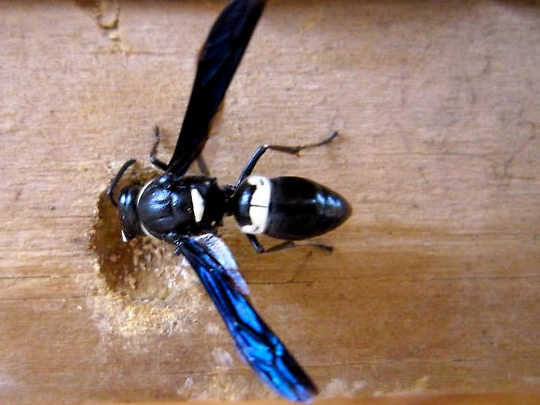
Carpenter Wasp FAQs Answered
I see a big black wasp going into a small hole in my wood every day. Should I spray it right now?
Resist the impulse. Spraying her at the entrance is often ineffective and risks a sting. She'll likely just fly off and return later. You're also contaminating the area with pesticide unnecessarily. The more strategic move is to observe to confirm it's a nesting site (look for fresh, coarse sawdust below the hole), then plan a treatment for dusk when she's inside, using a method like insecticidal dust applied precisely to the entrance.
Can carpenter wasps cause structural damage like termites?
No, not in the same way or speed. Termites consume wood for nutrition, actively weakening it from the inside out, often hidden from view. Carpenter wasps excavate tunnels for nests. A single nest is minor. The structural risk comes from long-term, repeated nesting in the same beam over many years, which can create a honeycomb of tunnels. The bigger issue is that their holes allow water ingress, leading to rot and decay, which truly compromises the wood. It's a slow process, not an emergency, but one to address.
Are carpenter wasps beneficial at all, or are they just pests?
This is the nuance most pest control articles miss. They are highly beneficial in a garden or natural ecosystem. As parasitoids, they are effective natural controllers of caterpillar populations, including some that are garden pests. If their nest is in a non-critical piece of landscape wood (a stump, a dead tree, a non-structural fence post far from your house), leaving them alone is a valid choice. They're part of a healthy insect population. The "pest" label only applies when their activity conflicts with human property.
What's the best long-term paint or stain to keep them from boring into my house trim?
They have a hard time starting a hole in hard, slick, intact surfaces. A high-quality acrylic or oil-based paint with a solid primer underneath is excellent. For stained wood, a solid-color stain that forms a film on the surface is more protective than a semi-transparent stain that soaks in. The key is maintenance—once the finish cracks, peels, or weathers, the underlying soft wood becomes attractive again. Regularly inspect and touch up paint on eaves, window trim, and railings.
I have old carpenter wasp holes from last year. What should I fill them with?
First, make sure they're inactive (no activity for several weeks). For small holes, a exterior-rated wood putty or filler works. For deeper tunnels, pack the hole with steel wool first (which also deters future chewing), then cap it with putty. Sand smooth once dry, then prime and paint. For a more permanent fix on larger holes, use a wooden dowel slightly larger than the hole, coat it in waterproof wood glue, tap it in, cut it flush, and finish. This restores some structural integrity.
The bottom line with carpenter wasps is to respond with knowledge, not knee-jerk fear. They are remarkable insects that play a role in nature. Most of the time, a sighting is just a curiosity. When their chosen real estate overlaps with yours in a damaging way, you now have a clear, step-by-step framework to assess the situation and act effectively, protecting both your property and your peace of mind.


Comments