In This Guide
- What Exactly Is a Brown Wolf Spider?
- Where Do Brown Wolf Spiders Live? (Spoiler: Maybe Near You)
- The Life of a Hunter: Behavior and Diet
- The Big Question: Are Brown Wolf Spiders Dangerous?
- Brown Wolf Spiders and Your Home: A Practical Guide
- Common Questions (The Stuff You're Actually Searching For)
- Final Thoughts: Rethinking the Brown Wolf Spider
So you saw something scuttle across your basement floor last night. It was fast, kinda hairy, and brown. Your mind might jump to the worst conclusions. But before you grab the newspaper (or the vacuum), let's talk. Chances are, you've met a brown wolf spider. And honestly? They're some of the most fascinating, and misunderstood, critters you can find around your home.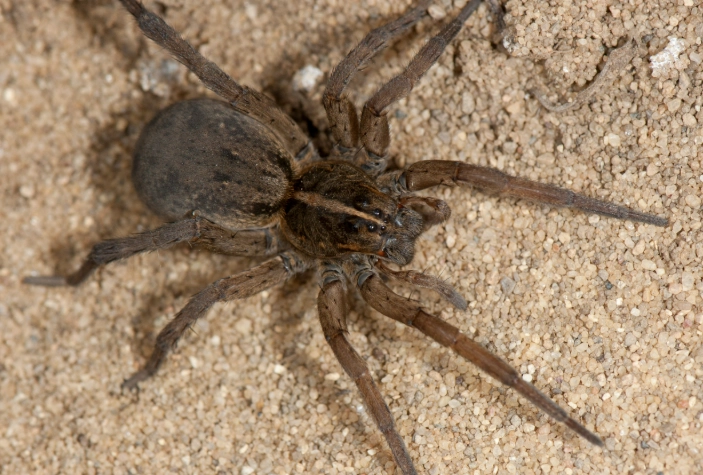
I remember the first time I got a good look at one. I was moving a potted plant on my patio, and this athletic-looking spider bolted out. It didn't run in a frantic, scared way. It moved with purpose. Stopped. Looked at me with those two prominent eyes in the front row of its eight eyes. I was more intrigued than scared. That started a rabbit hole of learning about them. Turns out, calling it just a "brown wolf spider" is a bit like calling a dog just a "brown dog." There's a whole world in that name.
Quick Take: Brown wolf spiders are solitary, ground-dwelling hunters. They don't spin webs to catch food. Instead, they chase it down like the wolves they're named after. They're common across North America and often find their way into garages, basements, and occasionally homes, especially in the fall.
What Exactly Is a Brown Wolf Spider?
Let's clear something up first. "Brown wolf spider" isn't the official name of a single species. It's a common name people use for a bunch of different wolf spider species that are, well, brown. It's a description, not a scientific label. The family is Lycosidae, and in North America alone, there are over 200 species. Many of them wear various shades of brown, gray, and tan, which helps them blend into the soil and leaf litter where they live.
Their color isn't just for show. That earthy brown is perfect camouflage. It lets them be ambush predators. They'll sit and wait, blending into a patch of dirt or bark, then sprint after an unsuspecting insect that wanders too close. Their speed is seriously impressive.
Spotting One: A Detailed Identification Guide
Okay, so how do you know it's a wolf spider and not a grass spider, a hobo spider (which is a different family altogether), or something else? Here’s what to look for. This is where getting over the initial "ick" factor pays off—if you can observe it calmly for a moment.
The Eyes Have It: This is the best giveaway. Wolf spiders have a distinct eye pattern. They have eight eyes total, arranged in three rows. The key is the bottom row: four small eyes. The middle row has two very large, forward-facing eyes. This gives them excellent binocular vision for judging distance when they pounce. The top row has two medium-sized eyes. No other common spider family has this specific layout. If you see those two big eyes staring back at you, it's likely a wolf spider.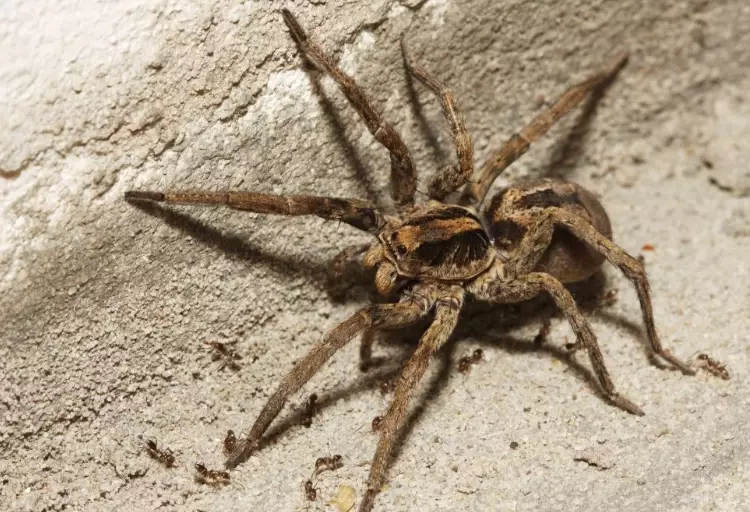
Body & Legs: They have a robust, hairy body. Their legs are also hairy and are typically banded or spotted with darker brown. They are stocky and built for power and speed, not delicate like an orb weaver. A mature female brown wolf spider can have a body length (the cephalothorax and abdomen combined) of up to an inch, with legs making them look much larger.
The Famous Carry: If you see a larger brown wolf spider with what looks like a smooth, pale grey ball attached to her spinnerets (the rear end), that's a female carrying her egg sac. She doesn't leave it in a web. She drags it everywhere with her. After the spiderlings hatch, they climb onto her back and ride around for a week or more. It's an incredible sight and a sure sign you're looking at a wolf spider mom.
I once watched a female with an egg sac for days near my woodpile. She was meticulous, always keeping it safe. When the babies hatched and swarmed over her back, it looked like she was wearing a living, moving fur coat. A bit creepy? Maybe. But mostly it was a powerful example of maternal care in the insect world—something you don't see every day.
Common Brown Wolf Spider Species
While many look similar, a few species are particularly widespread and often get the "brown wolf spider" label. Here’s a quick comparison of two you're likely to encounter:
| Species (Common Name) | Key Identifying Features | Typical Habitat |
|---|---|---|
| Carolina Wolf Spider (Hogna carolinensis) |
One of the largest in North America. Dark brown with pale, lengthwise stripes on the cephalothorax. Underside is solid black. Legs are uniformly colored. | Open fields, grasslands, pastures. Will dig burrows. Less common inside homes. |
| Rabid Wolf Spider (Rabidosa rabida) |
Light tan or yellowish-brown with two dark, bold stripes running the length of the cephalothorax. Abdomen has a central dark stripe flanked by lighter areas. | Grassy areas, forest edges, and very commonly in and around homes, garages, and basements. |
| Various "Ground" Wolf Spiders (Genus Pardosa or Schizocosa) |
Smaller, darker brown, often with more pronounced banding on the legs. Very fast and agile. | Leaf litter, gardens, under stones, and on the ground in wooded areas. |
For accurate species identification, especially if you're really curious, resources like the American Arachnological Society or university entomology departments have detailed guides. I find the bug guide from Iowa State University incredibly helpful for narrowing things down with pictures.
Where Do Brown Wolf Spiders Live? (Spoiler: Maybe Near You)
These aren't tropical spiders. They're hardy, temperate-climate survivors. You can find various brown wolf spider species throughout most of the United States and Canada. They're absent from the extreme Arctic, but otherwise, they're pretty widespread.
Their preferred home is outdoors. They love places where they can hide and hunt:
- Under rocks, logs, and landscape timbers.
- In leaf litter and dense ground cover.
- In burrows they dig themselves or take over from other insects.
- Around the foundations of houses, in mulch beds, and in woodpiles.
So why do they come inside?
Usually, it's an accident or a search for something. A male might wander in looking for a mate. An individual might chase prey through a crack. In late summer and fall, as temperatures drop, they might seek shelter. They don't infest homes like ants or German cockroaches. They don't have colonies. Finding one brown wolf spider doesn't mean there's a nest in your walls. It's usually just a single, lost hunter.
Important Note: They are not adapted to live long-term indoors. The environment is too dry, and they struggle to find enough food. A brown wolf spider inside is often a spider that won't survive long. It's more lost than invasive.
The Life of a Hunter: Behavior and Diet
This is where wolf spiders earn their name and a lot of my respect. Their hunting strategy is pure, active pursuit. No sitting around waiting for a web to vibrate.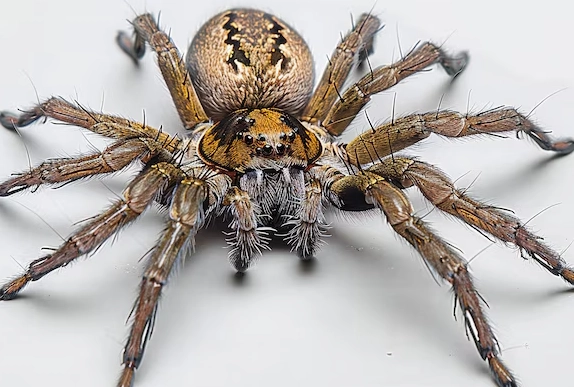
Night Stalkers
Most brown wolf spiders are nocturnal. During the day, they hide in their retreats. At night, they emerge to patrol their territory. They use their excellent eyesight and vibration sensitivity to detect prey. When they find something—a cricket, a cockroach, a beetle—they give chase, overpower it with their strength and venom, and liquefy its insides to eat.
Think about that in your garden. A single brown wolf spider can consume a significant number of insects every night. They're a free, natural pest control service. I've noticed fewer crane flies and ground beetles around my porch light since a few wolf spiders took up residence in the flower bed below. Coincidence? I don't think so.
Mating and the Next Generation
Mating is a risky dance for males. He has to approach a potentially larger female without becoming her next meal. He uses complex leg and pedipalp (those small, arm-like appendages near the mouth) signals to communicate his intentions. If successful, he mates and usually beats a hasty retreat.
The female then produces the iconic egg sac. She carries it for weeks. After the spiderlings hatch and ride on her back, they eventually disperse by "ballooning"—releasing a strand of silk to catch the wind. This is how they colonize new areas. The mother usually dies not long after, having spent all her energy on the next generation.
The Big Question: Are Brown Wolf Spiders Dangerous?
This is the heart of most people's fear. Let's be direct.
They have venom. Yes. All wolf spiders have venom to subdue their prey. It's a tool for hunting insects.
Are they aggressive towards humans? No. Their first and second and third choice is to run away. They have no interest in you. You are a giant, terrifying obstacle, not food.
Will they bite? Only in extreme defense. This usually happens if they are trapped against your skin—like if you put on a glove or shoe they're hiding in, or accidentally roll over on one in your sleep (very rare). They don't go looking for a fight.
What Does a Brown Wolf Spider Bite Feel Like?
If a bite does occur, most people compare it to a bee sting. The effects are typically local and mild:
- Instant, sharp pain at the bite site.
- Redness, swelling, and itching that can last for a few days.
- Sometimes a small, hard bump forms.
Their venom is not considered medically significant for most healthy adults. It's designed for bugs, not people. However—and this is crucial—any bite can cause an allergic reaction in sensitive individuals, just like a bee sting can. Also, any puncture wound can become infected if not kept clean.
If Bitten: Wash the area with soap and water. Apply a cold pack to reduce swelling. Monitor for signs of a severe allergic reaction (difficulty breathing, swelling of the lips/throat, dizziness) or infection (increasing redness, pus, fever). If you experience severe symptoms, seek medical attention immediately. For reliable medical information on spider bites, the CDC and Poison Control websites are authoritative sources.
Let's be real. The danger from a brown wolf spider is massively, almost comically, overblown. You are in far greater danger driving to the store for spider spray than you are from the spider itself. The fear is psychological, not physiological.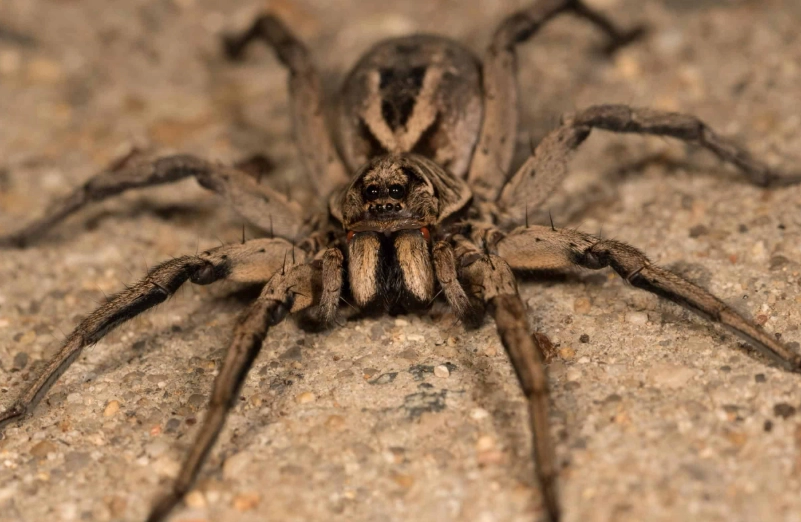
Brown Wolf Spiders and Your Home: A Practical Guide
I get it. Even knowing they're harmless, you might not want them as house guests. That's fair. The goal shouldn't be eradication—that's impossible and ecologically silly—but peaceful management and exclusion.
Prevention: Keeping Them Out
- Seal Entry Points: Check for gaps around doors, windows, utility pipes, and foundation cracks. Use caulk or weatherstripping. This helps with all sorts of pests, not just spiders.
- Reduce Outdoor Harborage: Keep leaf litter, grass, and mulch away from your home's foundation. Store firewood and lumber off the ground and away from the house.
- Control Other Insects: Since wolf spiders are hunting for food, reducing their prey (like crickets and cockroaches) inside your home makes it less attractive. Fix leaky faucets, don't leave pet food out, and manage trash.
- Use Yellow "Bug" Lights: For exterior lights, use yellow or sodium vapor bulbs. They attract fewer night-flying insects, which in turn attracts fewer spiders looking to eat them.
Safe Removal: If One Is Inside
Please don't kill it. There's no need. The classic "cup and card" method works perfectly.
- Take a clear cup or glass and a stiff piece of paper or cardboard.
- Slowly place the cup over the spider.
- Slide the card underneath, trapping it against the glass.
- Carry it outside and release it in a sheltered spot, like near a shrub or woodpile.
It's simple, humane, and you avoid the icky cleanup. I keep a dedicated "spider cup" in my utility room just for this.
What About Pesticides?
I'm not a fan of broad-spectrum indoor sprays for the occasional spider. They introduce chemicals into your living space for a problem that isn't really a problem. Spot-treating cracks and crevices on the exterior with a residual insecticide can be part of an integrated pest management plan if you have a persistent issue, but it's often overkill for wolf spiders. Their populations are controlled naturally by birds, wasps, and other predators.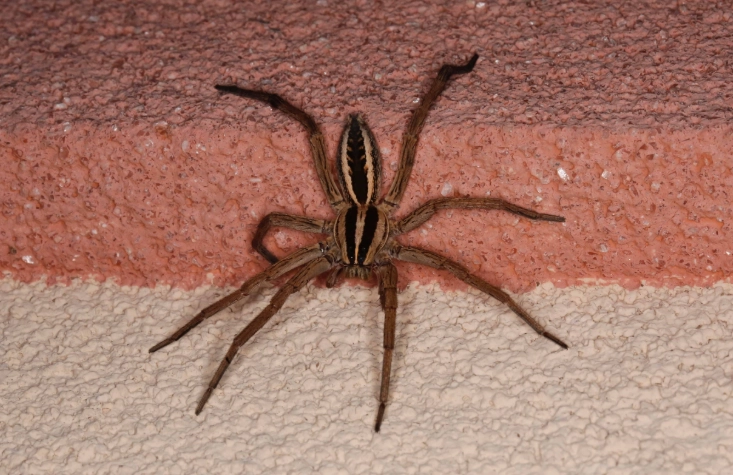
Common Questions (The Stuff You're Actually Searching For)
Final Thoughts: Rethinking the Brown Wolf Spider
Look, I'm not asking you to love them. A healthy respect is fine. But I hope you see them differently now. That brown wolf spider in your garage isn't a monster. It's an amazing little predator that got lost. It's a sign of a healthy ecosystem right outside your door, one that's working hard to keep actual pest insects in check.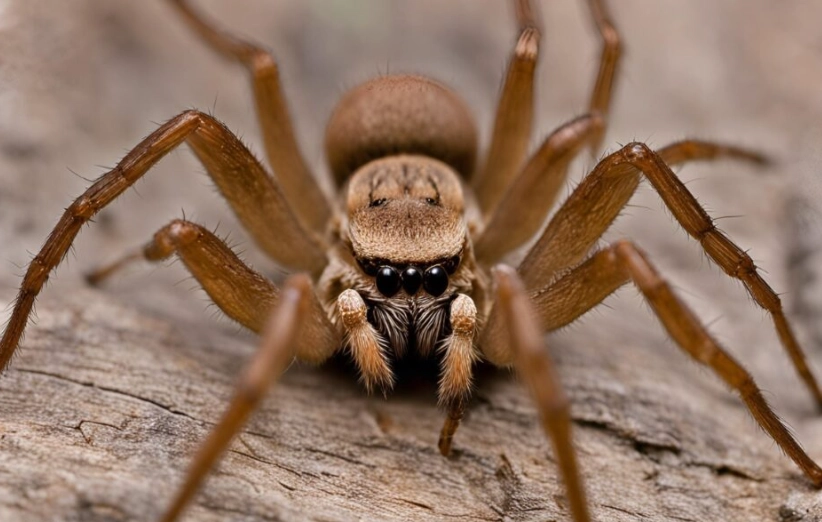
Their bad reputation is a mix of their speed, their size, and our own ingrained fears. But when you learn about their fascinating hunting style, their dedicated maternal care, and their absolute harmlessness to us, the fear starts to melt away. It gets replaced by curiosity, and maybe even a little admiration.
Next time you see one, take a breath. Watch it. See how it moves with such purpose. Then, if it's indoors, kindly show it the door. It has a job to do out there, and you'll both be happier for it.
Writing this made me go check my own woodpile. Sure enough, a small, dark brown wolf spider was tucked under the tarp edge. I watched it for a minute before it ducked back into the shadows. We have an understanding now. It stays outside and eats the bugs, and I get to enjoy a bug-free patio. Seems like a pretty good deal.
LEAVE A REPLY
Your email address will not be published. Required fields are marked *