Quick Guide to Kansas Water Snakes
- What Exactly Is the Common Water Snake in Kansas?
- Spotting One: A Detailed Identification Guide
- Home Sweet Home: Habitat and Where to Find Them
- Life of a Kansas Water Snake: Behavior and Diet
- Safety First: Are They Dangerous? What to Do If Bitten
- Conservation and Why They Matter
- Frequently Asked Questions (FAQs)
So you're out by a pond, creek, or maybe even the Kansas River, and you see a snake slipping into the water. Your first thought might jump to "water moccasin" or "cottonmouth," sending a little jolt of panic. Hold on. Chances are, incredibly high chances, you've just met the common water snake. It's one of the most frequent, and most frequently misunderstood, reptiles you'll encounter in the Sunflower State.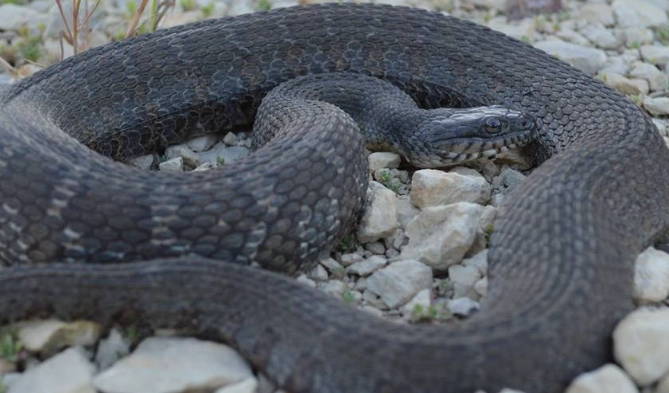
I've spent a good amount of time poking around Kansas wetlands, and I can't tell you how many times someone has pointed at a common water snake and declared it a deadly menace. It's a shame, really. This snake gets a bad rap it absolutely doesn't deserve. Let's clear the air—or rather, clear the water—and get to know this fascinating native.
This guide is for anyone from the curious hiker to the concerned homeowner. We'll cover how to confidently identify it, where it lives, what it does all day, and most importantly, why you don't need to fear it. By the end, you'll be the one calmly explaining to your friends that the common water snake in Kansas is a beneficial neighbor, not a villain.
Quick Take: The "common water snake" in Kansas is almost always the Northern Water Snake (Nerodia sipedon). It's non-venomous, common near any permanent water source, and plays a crucial role in controlling fish and amphibian populations. Misidentification is its biggest problem.
What Exactly Is the Common Water Snake in Kansas?
First, let's nail down the name. When people in Kansas say "common water snake," they are almost universally referring to the Northern Water Snake (Nerodia sipedon sipedon). It's a subspecies of a wider group, but for all practical Kansas purposes, this is your guy. You might also hear it called a banded water snake or just a plain old water snake.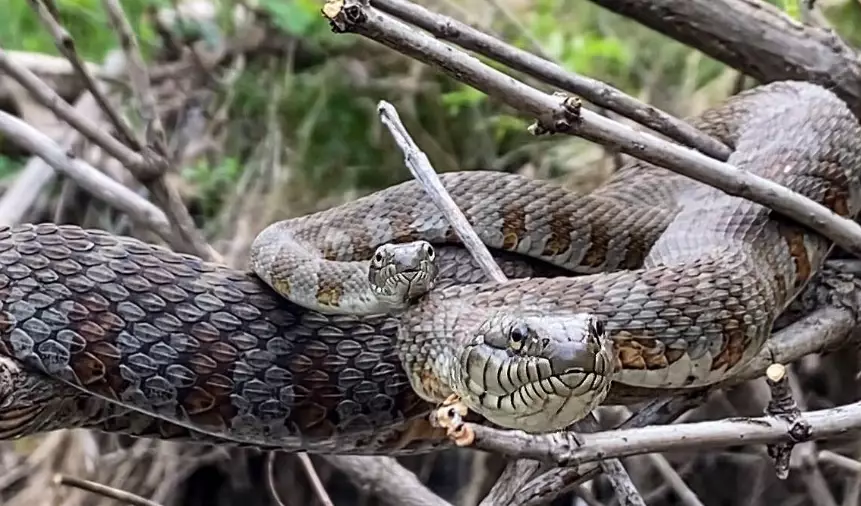
It's a medium-to-large, stout-bodied snake that is, as the name screams, almost never found far from water. It's a member of the Colubrid family, which includes the vast majority of North America's non-venomous snakes. Think of it as the dedicated aquatic specialist of the Kansas snake community.
Now, here's a point of confusion. Kansas is also home to a couple of other water-loving snakes, like the plain-bellied water snake in the far southeastern corner. But if you're anywhere in the central, northern, or western parts of the state, and you see a snake in the water, you can bet your boots it's the Northern Water Snake. It's the undisputed champion of Kansas waterways.
Spotting One: A Detailed Identification Guide
Okay, so what are you looking for? This is where details matter, because from a distance, a beefy common water snake can look intimidatingly similar to a venomous snake to the untrained eye.
Physical Appearance & Markings
Their coloration is highly variable, which doesn't make it easy. Juveniles and adults can look different, and individuals from murky water versus clear water can have different base shades. Generally, you're looking at a base color of gray, tan, brown, or even reddish-brown.
The key pattern is a series of dark, irregular crossbands or blotches on the back that alternate with smaller blotches on the sides. As the snake ages, these patterns often darken and can sometimes become less distinct, making older snakes appear almost uniformly dark brown or black. This is when most of the misidentification happens—a big, dark snake in the water looks scary.
The belly is usually a striking contrast: cream, yellow, or tan with prominent half-moon shaped markings of red, brown, or black. If you can safely see the belly, it's a dead giveaway.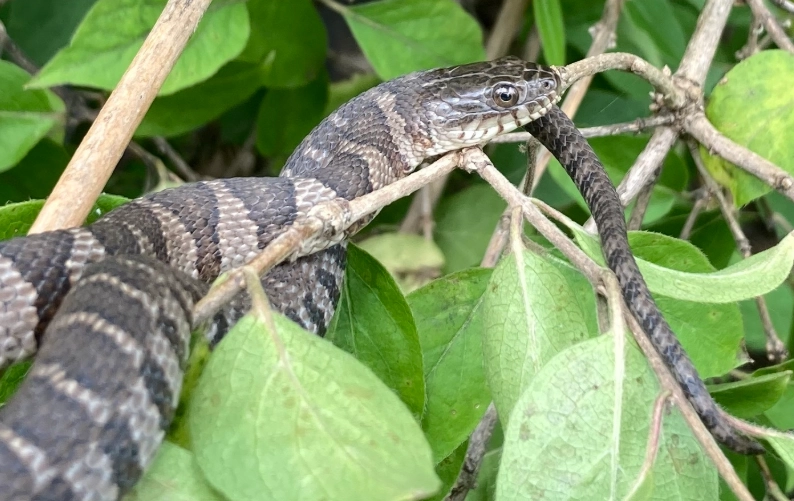
Their head is fairly distinct. It's relatively narrow and flat, which helps with swimming, but it's not dramatically wider than the neck like a venomous pit viper's (think copperhead or cottonmouth). The scales are keeled (having a ridge down the center), giving them a rough, matte appearance, not shiny.
Size: How Big Do They Get?
Females are larger than males, which is typical for snakes. An average adult common water snake in Kansas will be between 2 and 3.5 feet long. Real bruisers, usually old females, can push 4.5 feet. That's a substantial snake, no doubt. A 3-footer coiled up on a sunny bank has enough presence to make anyone pause.
I remember once seeing one that had to be pushing four feet draped over a low-hanging branch over a farm pond. From ten yards away in the low light, my heart did skip a beat. But the binoculars confirmed the narrow head and the banded pattern. Just a massive, beautiful, and completely harmless common water snake soaking up the sun.
Common Look-Alikes in Kansas (And How to Tell Them Apart)
This is the critical part. Mistaking this harmless snake for a dangerous one is bad for everyone—it's bad for the snake, which often gets killed, and it's bad for you, causing unnecessary fear.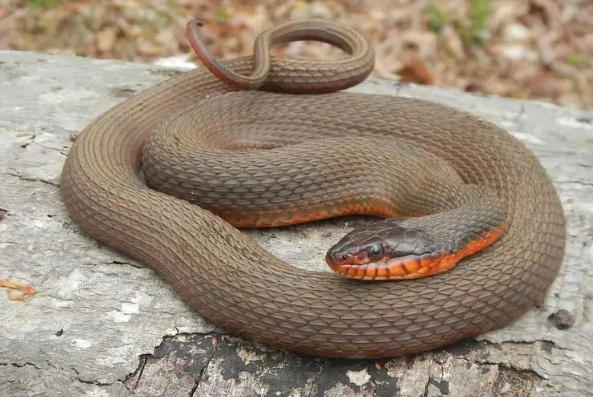
| Snake | Key Differences from Common Water Snake | Venomous? | Likelihood of Confusion |
|---|---|---|---|
| Northern Water Snake (The one we're talking about) |
Dark bands/blotches on back, alternating side spots. Narrow head, round pupils. Keeled scales. Almost always in/very near water. | NO | N/A |
| Western Cottonmouth | NOT found in Kansas. Its range ends in southern Missouri. If someone tells you they saw a cottonmouth in KS, they are almost certainly wrong. | Yes | Extremely High (but based on error) |
| Copperhead | Distinctive "Hershey's kiss" or hourglass-shaped crossbands. Coppery-red head. Prefers wooded hillsides, not open water. Vertical pupils (hard to see). | Yes | Moderate (from a quick glance at pattern) |
| Plain-bellied Water Snake | Range limited to extreme SE Kansas. Belly is plain yellow, orange, or red with no markings. Pattern is less banded, more uniform. | NO | Low (geography limits it) |
| Graham's Crayfish Snake | Much smaller, thinner. Has a distinct yellow belly with a single row of black dots. Specializes in eating crayfish. | NO | Low (size and specialty differ) |
The cottonmouth mix-up is the big one. It's a persistent myth.
Let's be clear. The western cottonmouth's range, according to every authoritative source like the University of Kansas Herpetology database, does not include Kansas. It stops in the Ozarks of Missouri. So if you're in Kansas and you think you see a cottonmouth, you are almost certainly looking at a dark, older common water snake. This single misidentification is responsible for more unnecessary snake deaths in the state than anything else.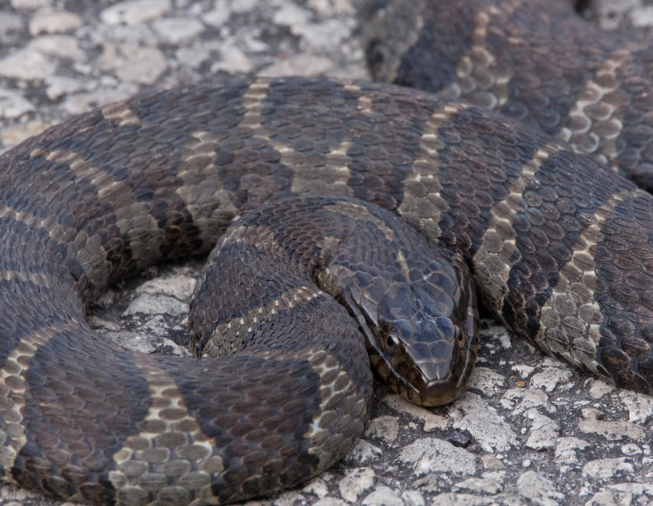
Home Sweet Home: Habitat and Where to Find Them
Want to find a common water snake? It's simple: find water. Permanent water. They are not fans of drying out.
- Rivers and Streams: The Kansas River, its tributaries, the Arkansas River—these are major highways for them. They love the rocky banks and slow-moving pools.
- Lakes and Ponds: From massive reservoirs like Milford and Clinton to the smallest farm pond. If it holds water year-round and has fish or frogs, it probably has common water snakes.
- Marshes and Wetlands: Cheyenne Bottoms, Quivira National Wildlife Refuge—these are prime real estate, offering endless hunting opportunities.
- Creeks and Ditches: Even smaller waterways will support them if they are reliable.
They are not picky about water quality, either. I've seen them in crystal-clear spring-fed creeks and in murky, slow-moving drainage ditches on the edge of agricultural fields. They are adaptable.
Their daily routine revolves around the water's edge. You'll often see them basking on logs, rocks, branches overhanging the water, or even on man-made structures like boat docks or spillways. When startled, their escape plan is always the same: a quick, silent dive into the water, where they can stay submerged for a surprisingly long time.
Life of a Kansas Water Snake: Behavior and Diet
So what does a common water snake in Kansas do all day? Mostly, it's about the hunt.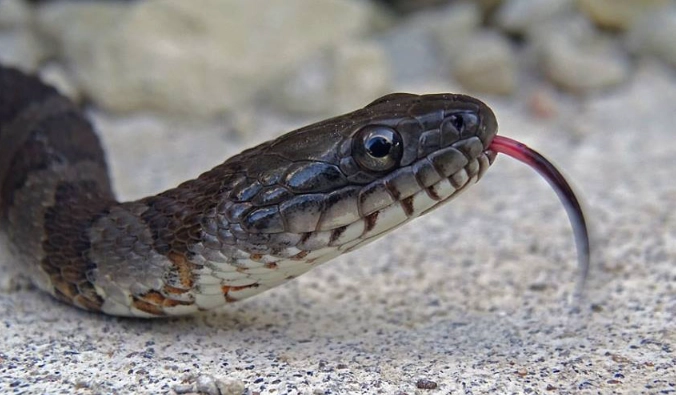
What's on the Menu?
These guys are opportunistic and voracious predators, and their diet reflects what's abundant. They are a key part of the aquatic ecosystem.
- Fish: The staple. They eat any small-to-medium-sized fish they can catch—minnows, sunfish, carp, bass, you name it. They are ambush predators, lying in wait and striking with lightning speed.
- Amphibians: Frogs, toads, tadpoles, and salamanders are a huge part of their diet, especially in smaller ponds.
- Occasional Prey: They'll also take crayfish, small turtles, other snakes, worms, and even small mammals or birds that come to the water's edge.
They don't constrict like a rat snake. They grab prey with their numerous small, sharp teeth and simply swallow it alive, often underwater. It's efficient, if a bit brutal to watch.
Activity and Temperament
They are primarily diurnal (active during the day), especially in spring and fall. In the heat of a Kansas summer, they may become more crepuscular, active at dawn and dusk.
Now, about temperament. This is where the bad reputation kicks in. Are they aggressive? Not really. Are they defensive? Absolutely, and understandably so.
If you corner one on land or try to grab it, it will not hesitate to defend itself. It will flatten its body to look bigger, release a foul-smelling musk from its cloaca (a mix of poop and other chemicals—it's awful), and strike repeatedly. It can bite hard for a non-venomous snake, and those small teeth can cause shallow, bleeding scratches that should be cleaned to prevent infection.
But here's the crucial thing: it does this because it's scared, not because it's aggressive. If you leave it alone, it will almost always choose to flee. Its first choice is always to slide into the water and disappear. The defensive display is a last resort. I've startled dozens while walking creek banks. 99% of the time, all I see is a splash.
A Note on "Aggression": That coiling, striking posture is pure defense. Think of it as a loud, dramatic "GO AWAY!" signal. It's not an attempt to hunt you. You are not prey. Giving the snake space is the solution to 100% of potential conflicts with a common water snake in Kansas.
Reproduction and Lifespan
Mating happens in spring after emerging from brumation (reptile hibernation). Females give birth to live young in late summer or early fall—anywhere from 10 to 30 baby snakes, each about 7-10 inches long. The babies are independent from the moment they are born and are miniature replicas of the adults, complete with the bold banding.
In the wild, their lifespan is probably around 5-10 years, facing threats from predators like hawks, herons, raccoons, larger fish, and unfortunately, humans.
Safety First: Are They Dangerous? What to Do If Bitten
Let's cut to the chase: No, the common water snake is not venomous. It is not medically significant. A bite from one is comparable to a scrape from a briar bush or a scratch from an angry cat—it will bleed, it might hurt, and it needs cleaning to prevent a bacterial infection, but it will not cause systemic poisoning.
If You Are Bitten (Which You Should Avoid)
- Stay Calm. You are not in danger from venom.
- Gently but firmly detach the snake. Do not yank, as this can tear your skin. Usually, if you stop moving, the snake will let go on its own to try to escape.
- Wash the wound thoroughly with soap and warm water for several minutes.
- Apply an antibiotic ointment and cover with a bandage.
- Watch for signs of infection (increasing redness, swelling, pus, fever). If these appear, see a doctor. The risk is from bacteria in the snake's mouth, not venom.
The best strategy, obviously, is to not get bitten. Observe from a respectful distance. If you need to move one from a path, gently encourage it with a long stick or spray it lightly with a hose from afar. Never try to handle a wild snake unless you are trained and confident.
Conservation and Why They Matter
Common water snakes are abundant in Kansas and are not listed as a species of concern. But "common" doesn't mean unimportant or expendable.
They play a vital ecological role as both predator and prey. They help control populations of fish and amphibians, and they themselves are a food source for birds of prey, mammals, and other snakes. Removing them can disrupt local pond and stream ecosystems.
Their biggest threat is persecution by humans who mistake them for venomous snakes. Every time someone kills a common water snake thinking it's a cottonmouth, they are removing a beneficial animal and perpetuating a myth. Education is their best conservation tool.
Frequently Asked Questions (FAQs)
Here are the questions I hear most often, the ones people are really searching for.
No. It is a non-venomous constrictor (though it doesn't constrict much—it mostly just swallows). It has no venom glands or fangs.
The most important fact: You can't, because there are no cottonmouths in Kansas to compare it to. If you're in Kansas, it's a common water snake or another harmless species. Range maps are the ultimate identifier. Trust the science from sources like the Kansas Biological Survey.
Celebrate! It means your pond is healthy. It will help control frogs and fish. Leave it alone. It poses no threat to you, your children, or your pets (unless you have very small fish it might eat). It will not overpopulate. If its presence absolutely cannot be tolerated, contact a local wildlife removal professional who will relocate it humanely.
Primarily daytime animals, but they can be active on warm, humid nights, especially in summer.
They are excellent climbers! It's very common to see them several feet up in shrubs or trees overhanging the water, basking or waiting to ambush prey.
Great blue herons, hawks (especially red-shouldered hawks), raccoons, foxes, larger snakes (like kingsnakes), and large predatory fish like bass will all prey on them.
You might see several basking together in early spring or fall. This is usually for thermoregulation (sharing warmth) or because a particular basking site is simply the best spot around. It's not social behavior, just practicality.
So there you have it. The common water snake in Kansas—a resilient, fascinating, and utterly harmless piece of our natural heritage. The next time you see that familiar shape slide off a log into a pond, you can smile knowing you're looking at a master angler, not a monster. Just give it the space it deserves, and enjoy watching a wild Kansas native go about its business.
Hopefully this guide has answered every question you could have. If you're still curious, the best thing to do is get out there (safely) and observe. There's no substitute for seeing one for yourself, now that you know what you're really looking at.
LEAVE A REPLY
Your email address will not be published. Required fields are marked *